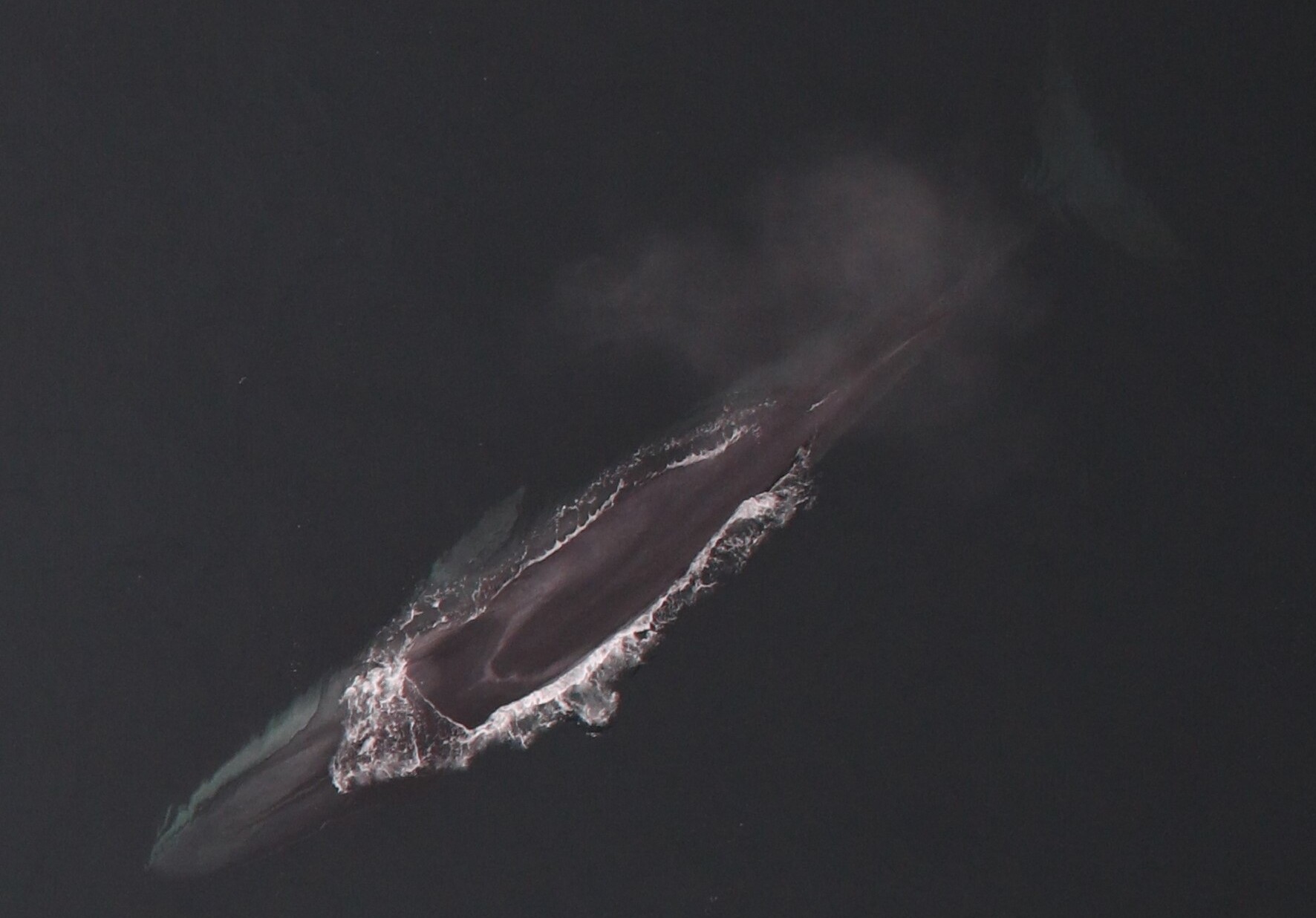
A 67-foot fin whale found dead at the Port of Tacoma was struck by a ship while still alive, a necropsy confirmed on Aug. 26.
KOMO News reported Northwest Seaport Alliance (NWSA) paid $8,000 to have the endangered whale towed from the port to McNeil Island on Aug. 25, where state and federal researchers performed the examination. Complete lab results will take months, but the gross necropsy established the cause: blunt force from a vessel strike.
Quigg Bros. Inc. Construction handled the tow. Charlie Quigg, vice president and co-owner, said the 10-hour trip required slow speeds to keep the carcass intact.
"Our marine superintendent is a very seasoned fella, and it's the worst smell he's ever smelled," Quigg told The News Tribune on Tuesday, Aug. 25.
The whale arrived on the bow of an Evergreen container ship that had traveled from China on Aug. 24. Jennifer Sepulveda, communications manager with the Washington Department of Fish and Wildlife (WDFW), said removing the whale from an active port area was necessary. The carcass will remain on McNeil Island to decompose naturally.
Michael Milstein, a public affairs specialist with the National Oceanic and Atmospheric Administration (NOAA), said the preference is to move whale carcasses to a nearby site with limited tidal and weather influence for examination.
McNeil Island, a restricted-access island near Steilacoom, is one of several sites the Washington Department of Natural Resources has designated suitable for whale decomposition.
A pattern of vessel strikes
The finding adds to a troubling record. Nine fin whales with vessel-strike evidence have stranded in Washington over the past 25 years, according to NOAA Fisheries data cited by KING5.
A previous case occurred at the same port in 2009, when a 46-foot young fin whale was found in the Blair Waterway and determined to be a ship-strike victim.
John Calambokidis, senior research biologist and founder of Cascadia Research, told KING5 on Aug. 24 that Washington has a long history of ship-strike impacts on fin whales.
Separately, Calambokidis told KIRO7 on Aug. 25 that of 15 whale strandings in the Washington portion of the Salish Sea over the last five years, seven showed signs of blunt force trauma consistent with vessel strikes.
Fin whales are the second-largest whale species, behind blue whales. They generally reach 75 to 85 feet and weigh 40 to 80 tons.
The species remains listed as endangered under the federal Endangered Species Act.
Broader whale mortality concerns
The fin whale death comes during a severe year for whale strandings statewide. As of July 6, 30 gray whales had died in Washington in 2026, five short of the 2019 record of 34, KING5 reported in July.
A normal year sees roughly four or five gray whale strandings, according to Calambokidis.
Researchers cited in that KING5 report linked the gray whale deaths to warming ocean conditions that reduce food availability. Malnourished whales face greater risk of vessel strikes and entanglement.
Full pathology and genetic testing results from the fin whale necropsy are expected in the coming months.