
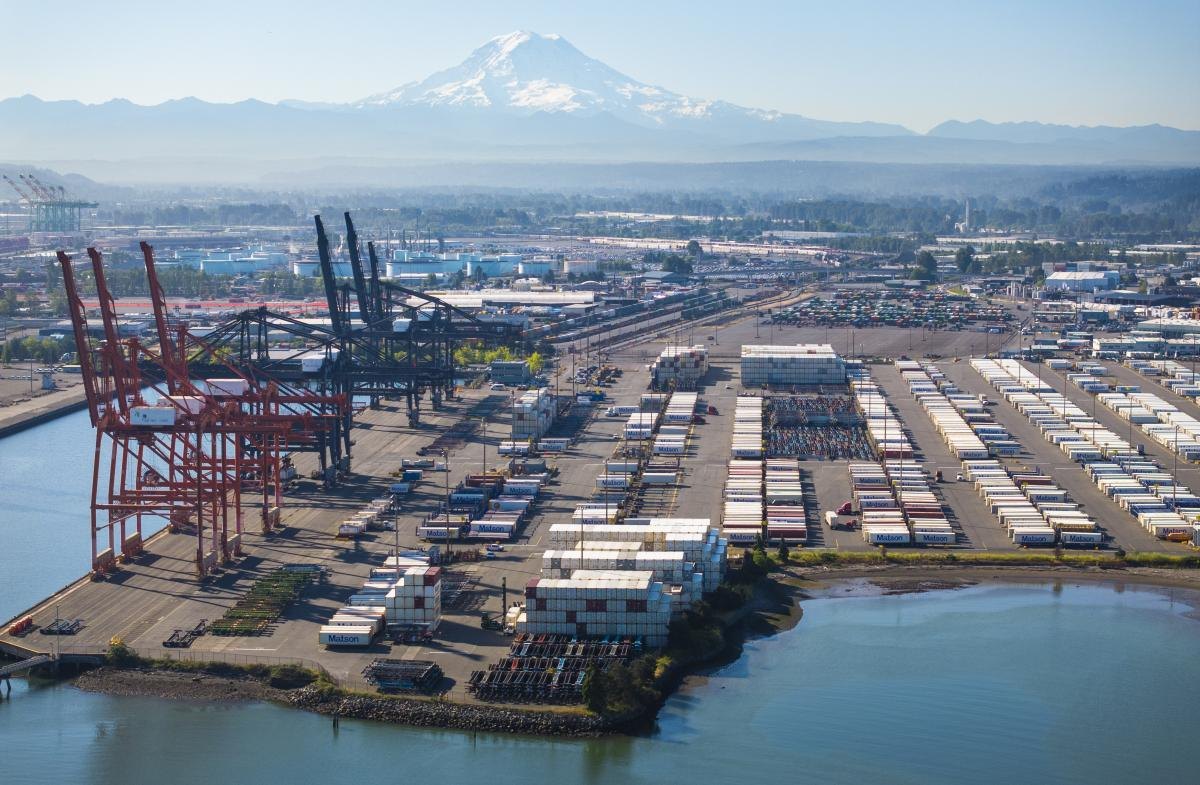
A nine-year federal lawsuit over stormwater pollution at the Port of Tacoma's West Sitcum Terminal has ended in a settlement that sends $500,000 to stormwater research and adds advanced cleaning equipment to the 140-acre container facility on Commencement Bay.
The Northwest Seaport Alliance, the Port of Tacoma, SSA Terminals, and Puget Soundkeeper announced the agreement June 2, resolving Puget Soundkeeper Alliance v. Port of Tacoma et al., a Clean Water Act citizen suit filed in 2017 over industrial stormwater runoff into the bay.
Under the deal, NWSA will pay $500,000 to the Washington Stormwater Center, a joint research program of Washington State University and the University of Washington, to fund stormwater management research and education. NWSA will also purchase a Triverus industrial sweeper, a machine originally developed for U.S. Navy aircraft carrier decks that uses 3,800 PSI spray cleaning to strip copper, zinc, and 6PPD (a tire-cracking preventive linked to coho salmon die-offs) from hard surfaces using high-pressure water rather than chemical solvents.
SSA Terminals (Tacoma) will make unspecified operational enhancements at the terminal.
"Resolving litigation of this complexity and duration is never simple," said Dick Marzano, NWSA co-chair and Port of Tacoma Commission president. "We're pleased to have reached an agreement that brings closure and delivers real environmental investments in our Tacoma Harbor."
The settlement builds on NWSA's prior $13.5 million investment in a stormwater treatment system at West Sitcum, completed in 2019. That system, designed by Parametrix, included three pumping stations, three hydrodynamic separators, and 28 media filtration units targeting copper and zinc levels under the state's industrial stormwater permit.
The agreement does not constitute an admission of liability by any party.
Puget Soundkeeper executive director Sean Dixon called the resolution a step toward improved conditions in Commencement Bay and surrounding communities.
Commencement Bay remains a federal Superfund site where fish consumption advisories are in effect due to PCBs, mercury, and other contaminants. According to NOAA, trustees have recovered more than $70 million in pollution settlements for bay restoration since 1991.
The settlement will be formalized in a consent decree that must receive federal court and U.S. Department of Justice approval before taking legal effect. The decree would remain enforceable through January 1, 2030. No court date for approval has been announced.