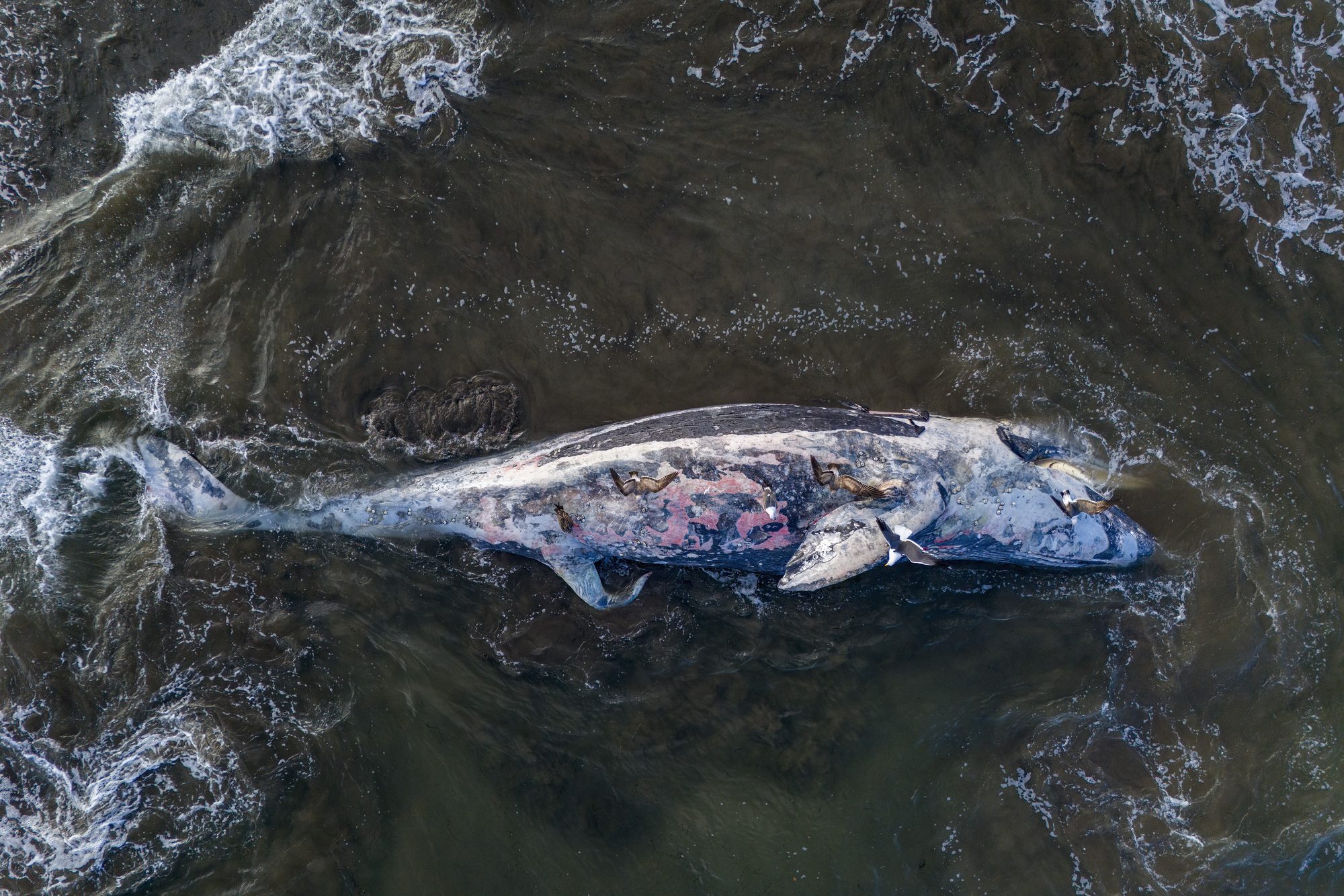
A decaying whale arrived at the Port of Tacoma on the bow of an Evergreen container vessel Aug. 24, prompting a joint investigation by the Washington Department of Fish and Wildlife and the National Oceanic and Atmospheric Administration.
The carcass was spotted along the Blair Waterway in Commencement Bay.
NOAA media specialist Michael Milstein told The News Tribune the animal may be a fin whale, the second-largest species on Earth, though WDFW had not confirmed the identification as of Monday afternoon.
WDFW was first notified around 5 a.m. Monday, according to communications manager Jennifer Sepulveda.
The Northwest Seaport Alliance learned of the whale at 6:15 a.m., said NWSA communications director Melanie Stambaugh Babst.
"At this time, we do not have information confirming how the whale died or whether it was struck by the vessel," Stambaugh Babst said.
The vessel's crew reported the whale was already dead when they encountered it. The level of decay suggests the animal may have been dead for several days before the ship reached port, Milstein said. WDFW scientists planned to analyze the body for signs of hemorrhaging, which would indicate the whale was alive at the time of a strike.
Nobody knows yet.
A News Tribune reporter driving along the Blair Waterway on Monday observed the body, which had turned pink and white, behind a fence.
Melissa Malott, executive director of Communities for a Healthy Bay, a nonprofit that monitors Commencement Bay for pollution, said Monday was the first time she had heard of a dead whale in the area in nearly a decade.
A Port/NWSA contractor was scheduled to remove the carcass Monday or Tuesday and transport it to an approved disposal site near McNeil Island, Stambaugh Babst said. Neither WDFW nor NOAA provided a timeline for completing the investigation.
If confirmed as a fin whale, the animal would be an endangered species. Fin whales can reach 85 feet long and weigh up to 176,000 pounds.
Washington has seen elevated whale mortality in 2026. As of June 16, 30 gray whales had died in the state, according to KING 5, five short of the 2019 record. A normal year sees roughly four or five strandings, according to Cascadia Research Collective biologist John Calambokidis. Those deaths involve gray whales, a different species from the suspected fin whale found Monday.