Tacoma residents who camp, haul firewood or tend ash trees in their yards face immediate consequences after state officials confirmed the emerald ash borer in Washington on Wednesday, Aug. 19.
A statewide ban on transporting untreated firewood had already taken effect the day before.
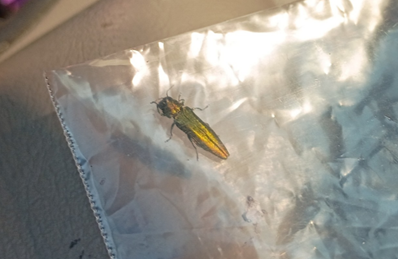
The metallic green beetle, roughly half an inch long, has wiped out more than 100 million ash trees across the United States since it was first detected about 20 years ago.
No state has ever successfully eradicated it. A Washington Department of Natural Resources analysis found that without intervention, a city can expect to lose 90% to 100% of its ash trees within 10 to 12 years of an initial infestation, according to The Seattle Times.
For Tacoma, that timeline is especially alarming. The city has the lowest assessed tree canopy cover in the Puget Sound region at roughly 20%, according to a 2018 assessment cited in city forestry documents, and is trying to reach 30% by 2030 under its Urban Forest Management Plan. The city's tree inventory, tracked in software called TreePlotter, logged more than 20,500 trees as of December 2023 but remains incomplete. No public count of how many are ash species is available.
What happened
Two people passing through Vancouver spotted the beetle on their windshield on Monday, Aug. 3, collected it and reported it to the Washington Invasive Species Council, according to a WSDA news release. The specimen was turned over to a state parks employee on Aug. 5, submitted to USDA on Aug. 6 and confirmed as emerald ash borer on Aug. 19.
"We anticipated it would only be a matter of time before emerald ash borer arrived in our state," said Sven Spichiger, pest program manager at the Washington State Department of Agriculture.
The beetle had already been detected in Forest Grove, Oregon, in 2022 and in Vancouver, British Columbia, in 2023.
The firewood quarantine
A statewide firewood quarantine took effect Tuesday, Aug. 18, one day before the official confirmation. It prohibits transporting untreated firewood anywhere in Washington. Campers heading to Mount Rainier, state parks or Pierce County campgrounds must buy firewood at their destination or use certified heat-treated wood.
WSDA says the only reliable methods to contain an outbreak are limiting firewood movement, removing infested trees and replacing them with non-ash species. The agency is urging landowners and homeowners to immediately stop planting new ash trees.
What it means for Tacoma's parks and streets
Metro Parks Tacoma manages more than 1,000 acres of forested parkland. The city's Urban Forestry Program, led by urban forester Mike Carey, had just three full-time staff as of 2023, against a management-plan goal of nine. Tacoma City Council strengthened tree protections in December 2023 with Ordinance 28926 and adopted an Urban Forest Priority Action Plan in May 2025.
The city's 2026 Grit City Trees free street-tree program, with applications open through Thursday, Sept. 3, already excludes ash species from its planting list, offering oaks, beeches, catalpas, ginkgos and other varieties instead.
WSU's Urban Forest Health Lab is conducting a volunteer "Grit City Tree Count" this summer, funded by a DNR Community Forestry Assistance Grant, to fill gaps in Tacoma's incomplete inventory.
How residents can help
State officials ask residents to watch for D-shaped exit holes in ash bark and report suspected sightings to the Washington Invasive Species Council at invasivespecies.wa.gov or through the Washington Invasives app. Financial and technical assistance for cities is available through the DNR Community Forestry Assistance Grant Program.
Neither Metro Parks Tacoma nor the city's Urban Forestry Program had issued a public response to the confirmation as of Thursday, Aug. 20.